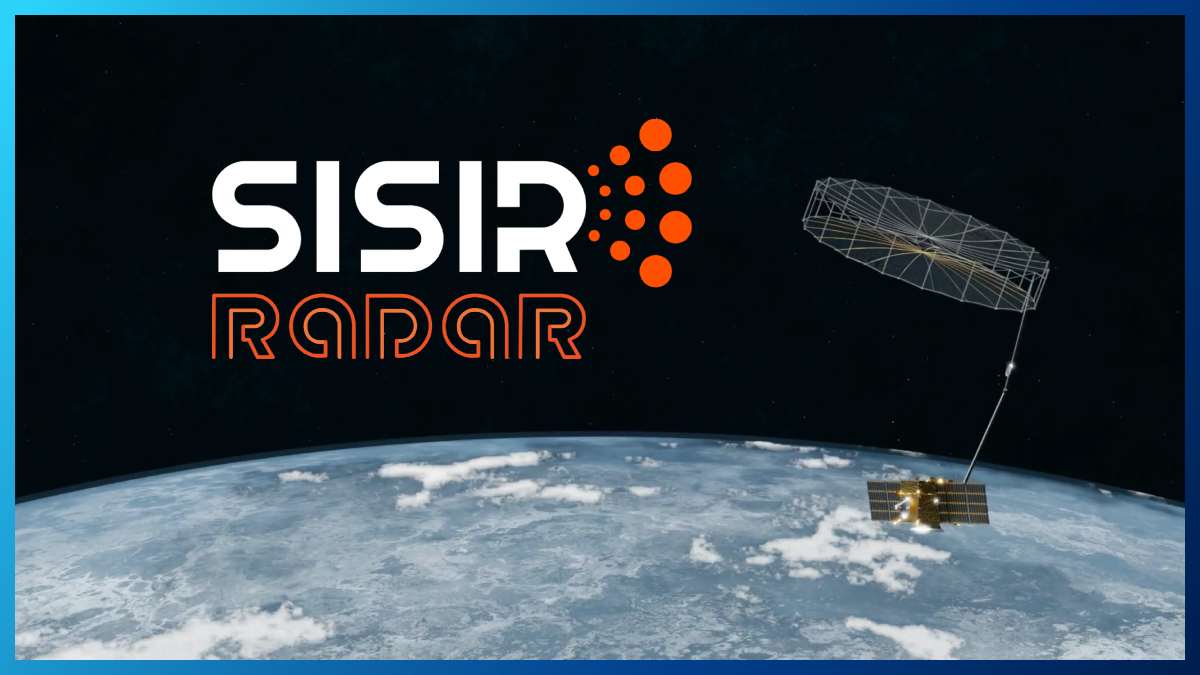
Sisir Radar, an Indian space and defence technology startup, has raised $7 million in its Series A funding round led by 360 ONE Asset, with participation from existing investor Shastra VC.
The funds raised will be used to develop and launch India’s first privately built L-band Synthetic Aperture Radar (SAR) satellite, targeted for launch by 2026. Designed, engineered and built in India, the satellite is expected to deliver high-resolution, all-weather imagery for national security, environmental monitoring, urban planning and disaster management.
Founded in 2022 by Tapan Misra, Sisir Radar is a deep-tech startup specializing in the design and development of advanced Synthetic Aperture Radar (SAR) systems for terrestrial, aerial, and space platforms. The company provides 24/7, all-weather monitoring solutions with applications in defence, agriculture, mining, and environmental monitoring.



Sisir Radar has built the world’s highest-resolution L- and P-band SAR and has won two iDEX challenges to build specialised SAR satellites for the Indian Air Force (IAF). It is also working with industrial stakeholders in defence and other sectors.
Synthetic aperture radar is an advanced remote-sensing technology that delivers continuous, high-resolution monitoring that is not affected by clouds, darkness, smoke or terrain. It is also developing next-generation systems mounted on platforms ranging from spaceborne to airborne to deliver 24/7 situational awareness.
Tapan Misra, Founder, Sisir Radar, said, “While the private sector across the world focuses on X-band SAR, India’s geographical nuances require the ability to not just see through clouds but also through vegetation for any meaningful application, be it military or civilian. This requires lower frequencies like L and P bands, where, conventionally, getting high resolution is challenging, but high resolution is imperative. This is what we have cracked for L and P bands. The level of SAR technology that we are building positions us in the same playing field as space agencies of top spacefaring nations. We are setting new benchmarks for what the private sector can achieve in space globally.”
Soumya Misra, Chief Executive Officer and Founder, Sisir Radar, said, “India’s strategic needs demand sovereign, high-precision sensing infrastructure built on indigenous technology. With this mission, we are proving that world-class deep-tech can be built in India for the world, rooted in scientific excellence, engineered for scale and driven by national purpose. This funding enables us to accelerate from prototypes to orbital assets and to position India at the forefront of global space-borne radar intelligence.”
Abhishek Nag, head of early-stage VC, 360 ONE Asset, said, “Space-based L- and P-band SAR is now core sovereignty infrastructure for any nation that takes border security, maritime domain awareness, and climate resilience seriously. What Sisir Radar is building is a full-stack radar company—from waveform design and on-board processing to ground systems and analytics—anchored in Indian IP and backed by domestic capital. For us, the truly exceptional part is the founding team: Dr Tapan Misra and his colleagues bring decades of systems-engineering experience from ISRO but are executing with the speed, frugality, and ambition of a startup. We believe Sisir can become one of the global reference companies in radar imaging.”
Vasant Rao, Managing Partner, Shastra VC, said, “Sisir Radar represents the kind of deep-tech ambition India needs. The startup has generated original IP, world-leading performance and a team that understands how to translate complex engineering into national capability. Their L- and P-band SAR systems are not just ahead of the global curve; they redefine what is technically possible at this price-performance envelope. We backed them early because we saw a generational opportunity, and we are doubling down because they continue to execute with precision and conviction.”
Urmi Bhambhani, Chief Technology Officer and Founder, Sisir Radar, said, “Our approach has always been to engineer radar systems end-to-end, with absolute control over hardware, software and on-orbit performance. The L-band mission is the epitome of years of first-principles design, advanced signal processing, and highly efficient SAR architectures. This capital infusion allows us to expand our R&D pipeline.”